


PJM announced the results of the 2027–2028 Base Residual Auction (BRA) at $333.44/MW-day. While the headline is familiar, the underlying signals are becoming harder for energy customers to ignore.
Once again, the auction cleared at the price cap, reinforcing that capacity resources remain tight across the PJM footprint. PJM procured 134,479 MW of capacity, which was 6,623 MW short of the region’s target reliability margin. It's the first auction in PJM history the entire RTO fell short, an outcome that highlights the growing strain the proliferation of data centers has placed on the system.
The results point to structural shifts that will influence capacity costs and risk exposure for years to come.
Clearing at the Cap—Again
The 2027–2028 auction cleared at $333.44/MW-day throughout the entire PJM footprint. The price is the maximum allowed under current auction rules. PJM estimates that without the temporary cap, the capacity price for 27-28 would have been around $530/MW-day. While temporary price caps were designed to limit volatility, clearing at the ceiling in back-to-back auctions signals a persistent imbalance between supply and demand.
Capacity prices reflect the cost of ensuring enough resources are available during peak demand periods. When prices repeatedly hit the cap, it suggests the system is operating with little margin for error. While this does not mean outages are imminent, it does indicate less buffer in the system as PJM plans for extreme weather events and peak conditions.
Several factors contributed to this outcome, namely rapid load growth (particularly from data centers), limited new generation, planned economic retirements of existing resources, and ongoing interconnection delays. Together, these pressures are tightening capacity availability faster than new resources are coming online. What's more is that analysts don't see that changing anytime soon.
What This Means for Energy Customers
Capacity auctions occur years in advance with their financial results directly impacting electricity bills. The 2027–2028 results reinforce several important planning considerations, namely, capacity costs are likely to remain elevated. Furthermore, budget volatility is becoming the norm, not the exception. For many organizations, capacity charges are now one of the most controllable—and overlooked—components of the electric bill.
Dismissing the trend carries increasing risk. Here's why...
Consider that 809.6 MW did not clear auction because the price for those resources exceeded the $333.44/MW-day cap. As the price cap becomes a deterrent for producers, feasibly this may reduce the amount of investment and corresponding supply in the PJM market. This alludes to a reality impacted by one of two scenarios: continued, and perhaps worsening, shortfalls or elimination/recalculation of the cap to capture more resources. At present, PJM’s next capacity auction will be held in July and since the price cap provision expired with this auction, unless it's reinstated, $530/MW-day capacity prices may be on the horizon.
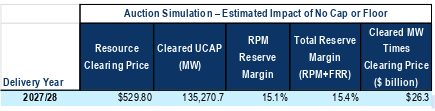
RPM Auction Resource Clearing Prices Results in the RTO With No Cap or Floor Simulation
Furthermore, the 2027-2028 auction secured only 14.8% of the 20% necessary reserve margin - a shortfall of 6,623 MW. Practically, the results reveal there isn’t enough committed power for 2026–2027 for PJM to meet their reliability goal. PJM forecasts capacity needs to assure outages from power shortages happen no more than once every 10 years. To do this, they aim to have 20% more electricity available than expected for use at peak times. This is called a reserve margin, and it helps protect against service loss from extreme weather, power plant failures, and unexpected demand spikes. A smaller reserve margin doesn’t mean outages are forthcoming, but it does mean the there's less room for fluctuations in supply and demand when extreme weather or equipment failures happen.
When a shortfall of more than 1% continues for two additional BRAs, it triggers a Reliability Backstop Auction (RBA). The RBA is PJM’s safety-net mechanism used when the BRA does not procure enough capacity to meet PJM’s required 20% reserve margin. Under these circumstances, PJM runs a targeted, administrative auction to secure the additional capacity needed to maintain grid reliability for the delivery year. Unlike the BRA, which is a competitive, market-based auction, the RBA is not price-optimized and typically procures specific resources at higher, more volatile costs. Those costs are ultimately passed through to customers as additional capacity charges. For commercial and industrial customers, increased capacity cost risk and growing price volatility make proactive strategies like demand response and peak load management more important than ever.
Steps You Can Take Now
A business’s capacity costs are largely driven by its Peak Load Contribution (PLC), or generally how much electricity the facility uses during the grid’s highest demand hours. Demand response programs help reduce that impact by incentivizing businesses to lower load during those peak periods in exchange for financial compensation. PLC management and load shifting strategies can translate to a lower PLC value and therefore a smaller share of capacity costs during the following planning year. Together, PLC management and demand response give businesses a practical way to take control of capacity-related costs instead of simply absorbing price increases.
While customers can’t control capacity auction results, they can control their exposure. Strategies such as demand response and peak load management can meaningfully minimize the impact of high capacity costs. The sooner business customers weigh available options and begin taking the steps necessary to implement successful load and cost control strategies, the more control they will have over the impact auction results have on their budgets.
Learn more through the following resources available through our capacity cost information center:
- Proven Strategies to Offset Your PJM Capacity Costs
- Ten Ways to Control Your Business Capacity Costs
- Demand Response Strategies to Offset Capacity Costs
Looking Ahead
PJM plans to conduct an Incremental Auction ahead of the delivery year, and stakeholder discussions around market reform, interconnection timelines, and large-load integration are ongoing.
For energy customers, the question is no longer whether capacity costs matter but how proactively they choose to manage them.